Why Don’t I Feel Like Myself Anymore?
Understanding the hormonal and physiological changes that can begin after 35
Save your seat
Wednesday, October 7, 2026 at 12pm ET · Free · 45 minutes
We start at 12pm ET today
Starts in
Why Don’t I Feel Like Myself Anymore?
You’re in. The player opens right here at 12pm ET. Keep this page open.

Hosted by PureMuze, with Sarah Bonza, MD and Angela Foster

Having trouble loading? Watch on YouTube
Thanks for being here.
This session has ended. The recording will be posted on this page and emailed to everyone who registered. Next up: Session 3, Wed, Dec 2, 12pm ET: Peptides, Hormones & the New Midlife Medicine.
Weren’t registered? Get the recording
Leave your email and we’ll send it as soon as it’s posted.
Where would you start?
Every program is clinician-led. A licensed clinician decides what, if anything, is prescribed.
Medical Weight Loss
For weight that stopped responding to effort after 40.
- Clinician-led GLP-1 programs
- Semaglutide and tirzepatide options
- Base labs where indicated
Microdosing
Lower doses for energy, appetite and holding on to muscle.
- Semaglutide or tirzepatide
- Gentler ramp, same oversight
- One injection a week
Female Menopause - HRT
Hot flashes, sleep, mood and dryness, treated as one system.
- Estradiol and progesterone options
- Non-hormonal options too
- Clinician decides what fits
Longevity
Recovery, sleep and cellular energy for the long game.
- NAD+, B12-MIC, sermorelin
- Injection, nasal or oral options
- Clinician reviews every intake
Hosted by PureMuze, with Sarah Bonza, MD and Angela Foster
TranscriptRead the full session
45 minutes, every word. Tap to open.
Lona: My name is Lona. I am in my mid-forties. I'm joining from Miami, and I co-founded PureMuze with my co-founder to really help myself understand more about this stage in life. I know I have a ton of questions, and also my girlfriends have a lot of questions, and this webinar will just serve as a fireside chat. We'll be able to go over so many topics, and I hope they're helpful to you, because navigating this part of life seems to be a little bit harder than the other parts, in our early twenties and thirties, et cetera.
Lona: So now we are at five minutes after, so I think hopefully most people have joined. I will go ahead and continue here with the program. A quick note before we begin. Because PureMuze is a telehealth company, I want to be upfront. We do offer prescription treatments, including peptide therapies, but today is not a sales pitch. There is nothing for sale in this session. This is general health education. Nothing any of us say today is medical advice for you personally, and being here does not make any of us your clinicians. We will not recommend products, ours or anyone else's. If we mention categories like hormone therapy or GLP-1s, it is only to educate, never to recommend. If anything we discuss feels relevant to you, please bring it to your own clinician and decide together what's right for you.
Lona: So now, let's get started. I'm going to ask the help of my colleague, Charles, to see if we can bring the experts on stage. Amazing, it works like magic. Hello, Dr. Bonza. Hello, Angela. Thank you so much for being here today with us. If you want to take a moment, maybe Dr. Bonza can say a sentence or two about yourself and your practice and how you help women. I've been following both of you, but maybe many of you that are watching have not followed yet. So please go ahead and introduce yourself.
Dr. Bonza: Sure. I'm Dr. Sarah Bonza. Thanks for having me today. I am a physician and menopause certified practitioner, and I have a telemedicine practice helping women through this transitional period in perimenopause.
Lona: Amazing, thank you. And you shared with me your age, but I don't know if you want to share it.
Dr. Bonza: I'm 49.
Lona: You look amazing. Angela, you're next.
Angela: So I'm Angela Foster. I'm tuning in from London in the UK. I spent years as a corporate lawyer running on adrenaline before retraining in women's health and performance. I'm also a menopause certified health coach, and I host the podcast High Performance Health. I'm also the creator of the Biosyncing Method, which really helps women optimize their health and longevity so they stop trading it for success. Thank you so much for having me here today. I am 50 years old, so I'm also right in the middle of this transition, so very relevant to all of us. Welcome to everyone, and thanks for having me here.
Lona: Wow, okay, amazing. Looking good, ladies. I'm very excited to have you here. I have so many questions for you, and I will go through them quickly, because I know we only have 45 minutes together and I want to make sure that we leave plenty of time at the end, because questions are trickling in from the audience. And I believe that those questions are sometimes the most important ones, that unlock something within each of us that helps us take the next step to that change that we want to make.
Lona: So diving right into it: what changes, and when? Why don't I feel like myself anymore? When does this actually start? Most people think it's a moment in their fifties. What do you hear from women who know something is different but they can't name it? What gets dismissed as just stress? If one of you wants to start off, please go for it.
Dr. Bonza: I can say the age range is much wider than we originally thought. Women as young as 35 can actually go through menopause, and they can start experiencing perimenopause in their late thirties. On average it's well into your forties. And those symptoms that women start to experience are a result of hormonal changes. Your progesterone levels slowly decline, and then you have these erratic estrogen levels at the same time, and they're both decreasing during that period. And many women have many different symptoms.
Angela: Yeah, I would agree with that. I think, as Dr. Bonza was saying, the symptoms are so varied, and when they start also really varies in age, and also depends a little bit on lifestyle as well. So many women reach that point where, as the title of this says, "I just don't feel like me anymore," and they can't quite put their finger on it. And it's happening in so many ways. Sometimes it's symptoms relating to things like brain fog. Sometimes it's body composition changes, which can make you feel really quite out of control, because you're doing so many of the right things and yet your body feels like it's not cooperating. It can be in the middle of the night. I think the symptoms are wide ranging, and they cross over with so many other things that I'm sure Dr. Bonza is seeing in her practice from a medical perspective, things like thyroid health and autoimmunity, and also, in terms of what I see, mental health issues. Your blood work starts to change. Just so many things are going on. I love the fact that you've organized this, Lona, because I think it's such a great way to support women through this transition.
Lona: Thank you. I have a lot of friends that are asking these questions to me, and I like biohacking and longevity. I've been doing this since maybe my late twenties, early thirties, when I started learning about this type of thing. But now that I'm in my mid-to-late forties, I'm seeing changes that I cannot fix with my usual good habits anymore. Something has changed. I don't know if it's the hormones, but I see certain areas where I'm like, what happened? I'm doing the same things, I'm doing the right things, but something else is happening. So that's a very good point.
Lona: So, why is it so hard to recognize? How does perimenopause actually present? What does it get mistaken for? And what changes for someone when they finally get a name for it? Do people feel different when they find out they're in perimenopause? This is also interesting.
Dr. Bonza: This is what I see frequently in my clinic. Some patients will see five different doctors trying to figure out what's wrong with them before they finally come to me. And usually they've read Mary Claire Haver's book and it was a light-bulb moment. The types of symptoms that women are going to doctors for at this age are sudden changes in mood, anxiety and depression that they've never experienced before. One striking statistic, I shouldn't say favorite, is that the average age of suicide among women is 51 years old, which is also the average age of menopause. So I think it's just not recognized in women. Some women have palpitations. A lot of women are having trouble with their marriages at this stage because of their mood changes. Energy levels are down, weight gain. These are all things that they go to the doctor for, but most physicians are not trained to recognize perimenopause, and so they start throwing antidepressants at women, or anxiolytics, and that kind of thing.
Angela: The way I describe it, in a way, is that your hormones gave you a bit of a pass for most of your life. Even though you had to deal with the changes month to month, and you may have had other gynecological issues you've had to deal with, they gave you a bit of a buffer. And then that veil gets pulled back and suddenly it's exposed, so everything about your lifestyle becomes apparent. I think reframing it as a really empowering time, that actually this is a really big opportunity to start looking at some of the things we're doing and seeing where I can take better care of myself. Because as women, what I see is we carry so much of an invisible load, we leave ourselves last on the list, and then we don't feel like we've got this resilience anymore. So many women will say, "I'm looking at my wearable, my HRV is chronically low, I'm not sleeping at night, I'm so tired, but I get into bed and I either can't fall asleep or I wake up at two or three a.m. and I can't get back to sleep." Part of this is giving ourselves permission to really start taking care of ourselves in this process, and I fully appreciate it can be difficult to do, because we're all super busy. The perimenopause transition arrives in a woman's life when she is often juggling so many things: children, possibly aging parents, that sandwich generation, and careers where you've advanced to a level where you're also responsible for a bunch of people. So it can be tremendously difficult. But the more we can have communities like this and come together and offer support, from doctors like yourself, Dr. Bonza, who really do understand that transition, and also in terms of our communities and our relationships, so much the better, because it is a challenging time.
Lona: Such a good point. And Angela, when we were speaking before the webinar, you told me a story about a woman who wasn't sleeping, and you told her, here are the things I think you should be doing, by looking at the different devices and the different tests. I thought that was really cool, and it opened my eyes, because I had no idea. Maybe it'll come up in a question in a few minutes, but I'm very eager to get to that: what are some things that people can do without, obviously, establishing that doctor-patient relationship? Here are some examples that could potentially apply. It might not be you, but some people might see themselves in them. I think those are very powerful.
Lona: But you were speaking about hormones. So is it all hormones, or is it something else? Which symptoms surprise people the most when they learn they're hormonal? Where does it show up, in sleep, energy, training and recovery? And why is it not all hormones sometimes? What else produces overlapping symptoms that women can start to separate, if possible?
Dr. Bonza: That's a big question. Should I take a stab at it? The big players at this stage of the game are estrogen and progesterone, and estrogen is the big player. We have estrogen receptors in 200 different body tissues, including muscle, including our glucose transporters, the proteins that actually bring the glucose into the cell, which interact with insulin, and that impacts our insulin resistance. A big role of estrogen is in the microbiome and the gut. It's a big player in our production of dopamine, which is our motivation hormone, and serotonin, which is our happiness hormone, basically. So you're losing your estrogen, the levels are really erratic at this time, and it impacts so many tissues in your body. On top of that, your progesterone is decreasing, and that's the one that's really responsible for your sleep. As women lose their progesterone, the most frequent symptom is waking up at two or three a.m. and having trouble falling back asleep. And then some have night sweats. In addition to that, you have an increase in your insulin level. Because of your decrease in estrogen, you have more insulin resistance, and insulin is the hormone most responsible for weight gain. And you have insulin and cortisol. As Angela was talking about how you lose that buffer, part of that buffer is your hormone production shunting away from estrogen and progesterone, and now you're getting more cortisol, and that is your stress hormone. So those are the big players at this stage in life that have a big impact on women's symptoms, especially high-functioning women, like Angela mentioned.
Lona: Yeah, I see that. And they can start early, in perimenopause, as early as you were saying.
Dr. Bonza: Yes. I have a colleague who is on full menopause hormone therapy at 35 years old.
Lona: That's interesting to hear, because people don't really talk about these things. I was chatting with my friend and she said, "At 40 I got onto HRT, and I feel so much better, my marriage is saved." And I was like, what? I had no idea. But it depends on the person, right? Because hormones also have a cost. My doctor was saying that you would really need to use them, because you're in a bad place otherwise; don't just use them because you're hearing about them all over social media. So that was interesting.
Angela: I don't know what you've found, Dr. Bonza, but certainly when I'm working with clients, and I've worked with other doctors, it's largely symptom-driven in terms of the hormones, because your blood levels are actually changing. You can test them, but they're changing quite a bit. But often the physical changes that we see, the improvements in insulin sensitivity, in metabolic health, in muscle mass, in reductions of body fat, are attributed to the lifestyle decisions that you make alongside: lifting weights, increasing muscle mass, doing some aerobic exercise to be supportive, really working on your gut microbiome and your nutrient status so you have more energy. The hormones are not necessarily going to dramatically help you gain extra muscle or lose body fat, but they can make a huge difference to the symptoms you're experiencing, which in turn feeds these healthier lifestyle behaviours. That's certainly what I've been seeing. Is that what you see, Dr. Bonza?
Dr. Bonza: Yes. And there's so much impact, even on cholesterol levels. I'll start women on estrogen and we'll see their cholesterol levels just come back down to normal. But this is the critical period for women to adopt healthy habits.
Lona: Great. What you said, Angela, is very interesting, because my next question is around testing. I know that both of you are very knowledgeable on the testing part, and I asked you a little about this before the webinar started, because I don't think there's a lot of education out there in terms of what needs to be tested. I hear DUTCH test, I hear DEXA scan, I hear, what did Dr. Bonza say, InBody scan. I would love for us to describe some of those to the people listening, because it's super important to test and see where you're at, versus just seeing something on social media and doing that because you saw it there.
Dr. Bonza: I do prefer serum testing over DUTCH testing. I feel like it's more sensitive and more accurate, and when we look at research data, they use serum levels and not the urine and saliva levels that the DUTCH test does. And, like Angela said, the levels are fluctuating from day to day. One day your estradiol may be elevated, and you may check it the next day and it may be critically low. That's one of the reasons they don't recommend physicians check hormone levels. But I practice differently for my patients. Your FSH, your follicle stimulating hormone, is the hormone that comes from your brain and tells your ovaries to produce estrogen, and we see that level start to increase as we get farther along in perimenopause and menopause. So that's one of the levels that can be checked. But I do check estradiol levels, progesterone and testosterone on women, and I also check insulin, because we can start to see insulin climbing very early in this process, and that helps women know how their hormones are impacting their metabolic health. But as a formal diagnosis, the gold standard is really a clinical diagnosis of perimenopause. The Greene Climacteric Scale is the most vetted scale for assessing whether or not you could be perimenopausal. I do have a quiz on my website, bonzahealth.com, across the top: take a free perimenopause quiz. You can answer that series of questions and you get a score that tells you the likelihood that you are in perimenopause, or maybe your symptoms are from something else.
Lona: Interesting. And the serum testing, is that something that insurance covers, or not really?
Dr. Bonza: It does. It depends on how you code it. But for the majority of my patients, I do put them through traditional labs with diagnostic codes.
Lona: Got it. Very cool.
Angela: I leave all the medical side to Dr. Bonza and then I work alongside. But I will look at clients' blood work to see where we can make some changes. I'm very interested in their lipid levels, cholesterol. Obviously we can only get so far with nutrition; sometimes medication is needed, and as Dr. Bonza said, using hormone therapy can move that lipid profile quite significantly. Then I look at things like fasting insulin and fasting glucose, and I assess that alongside some sort of biometric testing, where we're looking at their muscle mass and, if we can, their bone density and body fat percentage, and their visceral fat, which is the fat that sits in and around the organs that you can't see. That really comes down to what the client has. Some of you listening will have something like a Tanita scale at home, or something like that, where you can begin to measure. They're not as accurate as going into a clinic, but because of the consistency with which you're doing it, you can get some really good data. I would just say do it at the same time of day under the same conditions, ideally in the morning, fasted, well hydrated, without caffeine. If we can, we have a look at a DEXA. I also look at their sleep data, if people are using wearables: their resting heart rate, their respiratory rate, which gives us an idea of how sympathetically driven you are at night. If you're quite stressed, often your breathing rate is going to be somewhat faster. We can also see heart rate variability, the inter-beat variability, to get an idea of your resiliency and your nervous system, alongside some other sleep metrics. And then I do some strength testing as well, so that when people are working with me they can see a result. It's exciting if you're making changes and actually seeing a result, seeing your body composition change, and then seeing that reflected back on your lab work, where your insulin sensitivity can improve, and your glucose and your HbA1c and things like that. So we have some longevity fitness testing that we do, and it varies from things you do at home to things you might do in the gym, to bring that together full circle. There's so much you can do. That's the message I would like to give to women: there's so much you can do to put yourself back in the driver's seat. If you're feeling out of control with it and your body isn't cooperating, there are many, many things you can do to help.
Lona: That's a really good point, Angela. So I'm wondering, in terms of managing it, where's the honest line between what you can change yourself and what warrants a clinician? One of you is a clinician, one is an expert in the field. What is that honest line, depending on where people are at? What actually moves the needle in nutrition, training and sleep? What's overrated? And what makes you say, don't wait, go see somebody?
Dr. Bonza: I can say what I experienced myself. When I started going through this "I don't feel like myself" time, part of that was overwhelming fatigue. I couldn't quite do what I used to do, and it was odd, because I've always been so motivated. I'm an over-functioning kind of person, and that's the way I've always been. As I entered perimenopause, I was exhausted, exhausted. And so many of my patients say that. So I feel like seeing the clinician early, to get a handle on what's going on, matters. My problem was that my ferritin level was low. Ferritin is not typically tested by traditional medical doctors. They're starting to recognize ferritin; the American Society of Hematology just put a new guideline out last month that finally recognizes that low ferritin can give you symptoms and should be treated by itself, independently. And ferritin interacts with your thyroid as well. So when patients come to see me, that's the first part we focus on: feeling better, getting the energy, so that they can go to someone like Angela and really start working on their muscle and their aerobic capacity. I feel like the two things should happen together, because some of these women are pushing so hard, and they're exhausted. You really have to take care of that part of it. I needed iron infusions. Once I got iron infusions I felt so much better, and then I started working with a trainer, then I started trying to focus on my HRV and my muscle strength. But I needed to feel better first in order to really start moving on that.
Lona: So I'm hearing it depends where you are. Angela, go ahead.
Angela: I was just going to say, a hundred percent, I couldn't agree more. What you were saying about ferritin is so important, and the two things come together; that's when you get the best result, understanding how you can get the assistance of different practitioners to help you and bring it together. I know in the US a lot of this is covered by insurance; in the UK it's on the NHS. The struggle is that people sometimes have difficulty with their doctor understanding "is my blood work optimal?" So I'd say this is the time to really advocate for yourself and press the medical team. Ask them: have you checked things like my iron, is it at an optimal range, not just an okay range, for me to really function? Because if you're feeling like a thought comes in and you can't hold on to it, that can be perimenopause and hormone changes, but it can also be low ferritin levels. And you won't have the energy to exercise; your mitochondria, the battery packs of your cells, are also affected by hormonal changes. So getting good blood work done at least annually, or more often if you're in a position to, so you can look at nutrient status and other things, to really optimize them. And then putting in place those lifestyle things as well.
Angela: I like to think of it as: find your domino. You can't do everything at once. If I said, okay, we're going to work on your sleep and your nervous system, you'd have a whole daily routine, and you'd be that person who wakes up in the morning and can't go anywhere for the first three hours because you've got to meditate and do mindfulness and get morning sunlight, and then you do an hour's work and you're like, oh my God, I've got to feed my kids and get to work. It can feel super overwhelming. So what I say is find what I call your domino: the one thing that's going to help tip down the others. Some people say to me, as soon as I get back into the gym and I'm exercising or going out running, and by the way, running doesn't make you fat, that's just not true, I know we hear that a lot on social media, so you get into your exercise, and in turn you start to eat better, then you start to sleep better, and it makes everything easier. If you can just find that one thing, your domino. We also have a quiz on my website, AngelaFosterPerformance.com, where you can do a questionnaire and find your domino. Find that one thing, because then everything else will start to fall into place, as opposed to thinking I've got to do everything at once.
Lona: That's so cool. I love the one domino. I want to pull back for a moment, because many women arrive treating eight separate problems. What changes when they see one system? What do you wish every woman knew ten years before she needed it? I just want to reframe it, because many people can feel overwhelmed with all the things that need to be changed, or in a certain order.
Dr. Bonza: One of the big factors, and one of the earliest symptoms that women see at this stage, is that their cycles are heavier, and when I say heavier, embarrassingly so. That is why so many women have low ferritin. Their estrogen levels are spiking and crashing, spiking and crashing, but each time it spikes your endometrium responds; that's the layer inside your uterus that sheds when you menstruate. That is one of the earliest signs of perimenopause, and women are losing ferritin during that process, and then they really start to have symptoms. It's one of the earliest presentations out there. So when women start noticing changes in their cycle, they should start thinking about: what's my ferritin level right now, how am I feeling?
Lona: Dr. Bonza, that's a very good point, because I had a friend, I still have a friend, who a couple of years ago had the exact issue you just mentioned, where her ferritin was very low and she was having very heavy periods. She was telling me and I didn't know what to share with her. She's three years older than me, so she's 49 now. Is it always heavier, or could it also be where your period gets to be less each cycle, less versus heavier?
Dr. Bonza: It's different for everyone. But early on, as a standard, you'll have heavier cycles early in the process, and then as you move through, you may notice your cycles are shorter: they used to be 30 days and now they're 26 days. Then, as you get even farther in the process, you start to see your cycles becoming farther and farther apart, and then you start missing cycles. That's just average. That's not everybody.
Lona: And should you be doing something during that time? If you notice a change, do you talk to your OB-GYN and say, hey, I'm seeing this, and what do they typically say? Do they just dismiss it? What should women ask for if they see something like this? Should they ask the OB-GYN to measure the ferritin, or ask for a certain thing?
Dr. Bonza: If you're feeling tired, if you're feeling not like yourself and experiencing that brain fog and fatigue, definitely. Then you need to start looking.
Angela: The thing with iron as well that's so difficult is that the heavy bleeding can cause a deficiency in iron, and then that deficiency in turn feeds more heavy bleeding. It's a cruel trick: when you are iron deficient, you're also more likely to have heavy bleeding, and then you're trying to get on top of it. So a lot of people will supplement with iron. But when you take an iron supplement you get a release of hepcidin, which actually makes it harder to absorb the iron. If we look at the research that's been done recently, taking your iron supplement every other day seems to lead to better bioavailability than taking it every single day. The other thing to think about is, if you're like me and you love to work out in the morning, then coming back and having your iron supplement with caffeine is going to interfere with it, or with something calcium-based, and if you've just done a workout, inflammation is rising, which also makes it harder. So as women it is a bit of a challenge, and I think we have to acknowledge that. If you can find a time of day to take it when you're going to absorb it that much better; you can also use things like lactoferrin, which can help facilitate some of that absorption, and eating things like red meat. But as Dr. Bonza has said quite a few times, getting on top of your ferritin is really important, especially in the early stages of perimenopause, because, as you were saying, Sarah, it limits the way you're thinking, your ability at work, your cognition. And a lot of people don't realize that low iron also feeds into anxiety, in addition to your workouts and everything else feeling harder.
Lona: Wow. Okay. Those are the questions I had prepared, and now we have some questions from the audience. The first one is: what's the best supplement for hot flashes with no side effects? Someone has hot flashes and wants to know the best supplement that doesn't give them side effects.
Dr. Bonza: I'm not sure how to answer that, because there are usually side effects. Most of the supplements are soy-based, which is a plant-based estrogen, which is not bio-identical, to use one of the terms we throw around. Those supplements bind harder to your estrogen receptors than your natural estradiol. That's something to be aware of. I know it's not directly answering the question, but that's one of the most popular supplements out there, and because it binds so tightly, I'm not a big fan of using those.
Angela: One thing that was quite interesting: I did a podcast interview not long ago with Dr. Sarah Berry, who's done research on soy isoflavones. What they were discovering is that it does seem to work for some people, but it depends on whether your gut bacteria produce S-equol, because that's what's having the effect. We do see that in places with more soy in the diet, in parts of Asia for example, women don't seem to have as many symptoms, I don't want to say an easier transition, and they tend to have more soy in their diet. But has their gut microbiome adapted to help them produce more of this S-equol? Not everyone produces it. I know there are some supplements coming now that actually contain S-equol, and I think they try to reduce the soy, which some people can be sensitive to, and isolate it. But any of these types of supplements, for example when people talk about things like ashwagandha, adaptogenic herbs are really, really strong. So working with a practitioner, as Dr. Bonza is saying, is actually really important, because they do have a powerful effect on the body. We often think, because it's a supplement, maybe not so much, but in actual fact they do, or they can.
Lona: That's a really good point, because a lot of people will throw ashwagandha around on social media like it's nothing. You'll see, "oh, I do this, this and that," and you look at it and you're like, should I be doing the same, because this person had this result? It's a reminder that what we see on social media we should always discuss with a professional and make sure it's exactly right for your body. I'm guilty of this myself. I see it and I just want a quick one-two-three tip, and then you run home and get the things and then you don't see the results, or maybe you did something you're not supposed to do. So that's a really good point.
Lona: I'm sure more questions are coming through, but while they are, do you want to share some instances where you've seen something in women in this age range, say something they were dealing with, like waking up in the middle of the night, and how you were able to fix it? Dr. Bonza, you had the patient this morning who wasn't feeling like herself. Walk us through how you helped that person. That would be really great.
Dr. Bonza: It usually starts with getting a really comprehensive history, understanding everything about them, because it's not just your body, it's also what you're experiencing in life, your stress level and work, that kind of thing. So it starts with getting a good history, a good story, hearing what the symptoms are. From there I do a very comprehensive panel of blood work, looking at cholesterol, hormone levels, metabolic indicators, your hemoglobin A1c, your insulin level, a random cortisol, which isn't as helpful but is still helpful if it's high. And then from there it's targeting what they need. Very frequently my patients are vitamin D deficient. I've had patients who had undetectable copper levels. Even copper: the minerals play a role in your health and your body's ability to do all of these chemical reactions. These minerals are at the core, and those are the kinds of things we fix. Very frequently we'll see early Hashimoto's thyroiditis, some autoimmune issues. It's a matter of treating each woman one by one. And it's often estrogen replacement, progesterone replacement, supplements. That helps with sleep, no question. Usually when my patients have trouble sleeping, when they take progesterone at night they feel like it's a miracle pill. I don't mean to be that much of an enthusiast about a medication, but progesterone does help women sleep at night. And then for those hot flashes, and muscle aches and pains, all kinds of symptoms, the next day after some of my patients start using estrogen they'll contact me and say, "Is it supposed to work this fast?" For some women it does. Not all women. But those are the big fixes, I guess you could say, that we do. In addition to iron infusions for probably 60 percent of my patients.
Lona: Thank you. Angela, I saw in your posts you were talking about things like L-theanine to take before sleep. I'm curious about that as well, because let's say you're not ready for the hormones yet, but is there something you can do to have a better sleep? I take magnesium myself, but if I need more, I'm looking into those other things you mentioned in your posts.
Angela: The thing is, when we're talking about sleep, before any of our sex hormones decline, melatonin starts to decline. So we need to be more on top of our sleep hygiene than we have been, coming back to this idea that the buffer is falling away. Making sure we've got really healthy behaviors around sleep, and it all starts with what you did in the morning: going outside and getting access to early morning light. It doesn't have to be sunshine. If you're in the UK and the sun's starting to wane over the coming months, just getting outside and getting access to morning light makes a big difference. It helps with the robustness of that cortisol awakening response, and it helps you to have a really good cortisol rhythm, where it comes up and then lowers across the day. That in turn helps with melatonin production at night, because they have an inverse relationship: if cortisol is high, melatonin is going to be low. Which brings me to the next point, related to what you're saying, Lona, which is to work on your stress and have a really good wind-down evening routine to bring your cortisol down and help melatonin to rise. I remember what you were referring to when we spoke: it was a conversation I had with a sleep scientist who basically said we're asking too much of sleep. We're asking sleep not only to completely repair and reboot our system and recharge our batteries, we're also asking it to be our wind-down and stress-relieving routine, which it isn't. So that entry into sleep is super important, and perimenopause exposes this for us, which is why many of us can't sleep. It's the hormones, but it's also the fact that before, we used to be able to go to bed, put our head on the pillow and fall asleep straight away. Now we can't. So making sure you have a really nice transition: a warm bath, a hot shower, something like that can really help, because you get a thermal dump and it helps cool your body temperature. In terms of supplements, there are a few, and again I would always say consult your practitioner, because I obviously can't give any advice here. L-theanine is very promising in terms of its ability to help you calm down. There are lots of studies in animal models that also look at it being potentially neuroprotective, especially when you're sleep deprived. That's not a reason to say, oh, I won't worry about my sleep and I'll just take L-theanine, definitely not, but it can help you relax. Phosphatidylserine can also be good. When we talk about magnesium, people often take magnesium glycinate, and the glycine is just a beautiful thing. It's very calming; it acts on GABA, on that same pathway, and helps you relax. It also cools your body temperature, so if you're somebody struggling with hot flashes, glycine can be helpful. What I like to do, and anyone from my community will have heard me bang on about this a few times, is have an evening ritual. I make a chamomile tea and put half a teaspoon or a teaspoon of glycine into it. It's quite sweet. Chamomile contains apigenin, which is also sleep-supportive and potentially longevity-enhancing, we don't know. The glycine helps cool your body temperature; it tastes sweet but only has a positive impact on blood sugar. That can be part of your evening ritual: put on some blue-light-blocking glasses, wind down, chill, and it can help with sleep. And because we don't produce quite as much glycine as we should, it's also helpful for glutathione production and for collagen production, so you're supporting some other things as well. That's one of the things I do every evening. I recently got one of my sons onto this routine in the evenings, and it works really nicely.
Lona: I love that. I also drink chamomile tea; I started lately, because I remember seeing my dad do it when he was so stressed growing up. Back in the day that's all we had; we didn't have all these beautiful supplements. I remember very clearly, every night he would do that because he'd be so stressed between all these jobs. Now I do it myself and I feel like him, but it's very calming to drink chamomile tea. I give it to my daughter and my son too. Now I need to think about the glycine, and how much, so I need to consult with a practitioner on that. Angela?
Angela: Just a little bit of glycine can be quite helpful, and it tastes nice and sweet as well.
Lona: Amazing. That's a really nice tip to end on. I know we promised 45 minutes and we have gone over, so to be respectful of your time I want to make sure we end on time. I know some of you still had questions, and you were on YouTube so you couldn't type them in here. However, you have both experts on the panel, and their information is on the landing page at puremuze.com/webinars. You'll see them there. Please follow them, interact with them and connect with them. If you have any questions, also direct them to us, if we can help you in some way. Thank you so much for being here. We will have one of these webinars each month coming up, so please join us for more. Thank you so much, Dr. Bonza. Thank you, Angela. I appreciate you. It was a pleasure. And thank you, everybody, for joining, and enjoy the rest of your day.
Angela: Thanks so much, Lona. Thank you.
Dr. Bonza: Thank you. Have a good one. Bye.
You may be sleeping differently, gaining weight in new places, feeling less resilient or more irritable, or simply wondering why your body suddenly feels unfamiliar.
The instinct is to blame stress, aging or a lack of discipline. But there may be real physiological changes happening underneath.
What you’ll learn
To help you understand what may be changing, so you can make better decisions instead of assuming you simply need to push harder.
What actually starts changing, and when: The hormonal shifts that can begin in your late 30s, years before anyone uses the word menopause, and why the timeline surprises almost everyone.
Why perimenopause is so hard to recognize: It rarely announces itself. We walk through how it actually presents, and why it gets mistaken for stress, burnout or aging.
Estrogen, progesterone and testosterone: What each one does, what happens as they shift, and how that shows up in mood, sleep, energy, libido and where your body stores weight.
When to manage it yourself, and when to get help: An honest line between what responds to changes you can make, and what genuinely warrants a clinician.
Who you’ll hear from
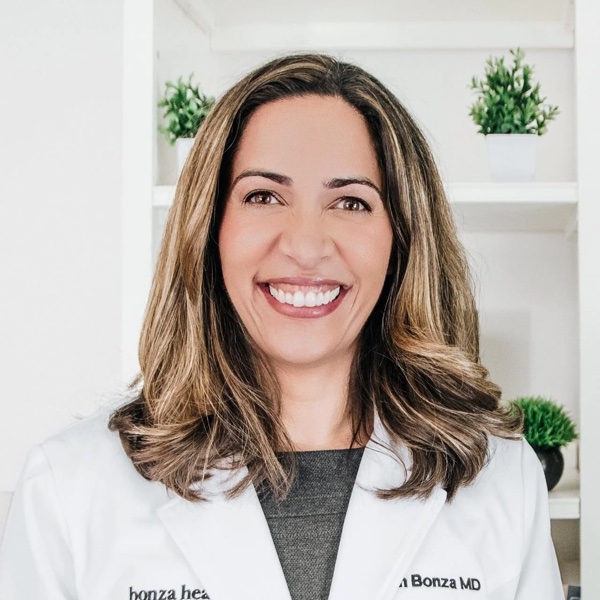
Board-certified family physician and Menopause Society Certified Practitioner. Founder, Bonza Health.
Nutritionist and health and performance coach. Host of the High Performance Health podcast.

Host, PureMuze Webinars
Questions about this webinar
The rest of the series
Tired, Wired & Still Not Sleeping
Why rest gets harder after 35, and how to rebuild a system that supports recovery
Date to be announcedSee the details →Peptides, Hormones & the New Midlife Medicine
What’s real, what’s hype, and how to tell the difference
Dec 2, 2026 at 12pm ETSave my seat →Why What Used to Work Doesn’t Work Anymore
Weight, metabolism and body composition after 35
Jan 6, 2027 at 12pm ETSave my seat →This session is general health education, not medical advice, and attending does not create a clinician-patient relationship. Nothing said is a diagnosis or a treatment recommendation for you specifically. Compounded medications are not FDA-approved and are not reviewed by the FDA for safety, effectiveness or quality. Speak with your own clinician about your circumstances.